
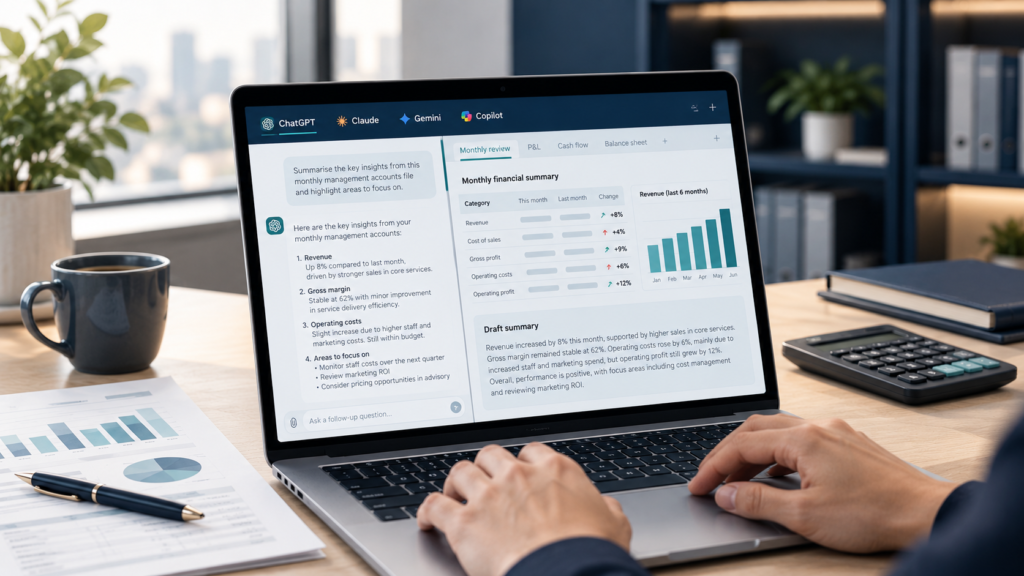
Learn how to use AI for the work that fills an accountant’s day: drafting client emails, summarising meetings, reviewing documents, explaining figures and researching questions. This practical course shows you how to give clearer instructions, check the results and build repeatable ways of working that preserve professional judgement.
Who it’s for
This course is for people in accounting and bookkeeping practices who want to use AI more effectively in their everyday work—and those responsible for reviewing that work.
It is particularly relevant to:
- Accountants and bookkeepers preparing client correspondence, working papers and commentary.
- Tax, payroll, audit and advisory staff using AI to organise information or support research.
- Practice managers and department heads looking for consistent working methods and credible productivity improvements.
- Reviewers and team leaders who need to assess AI-assisted work.
- Trainees and support staff developing practical AI skills within the firm’s arrangements.
You do not need advanced technical skills or prompting experience. The course builds on basic AI safety awareness and is a practical next step after AI Safety Essentials for Accountancy Practices.
What the firm gains
A fast AI draft only helps when the finished work is accurate, appropriate and worth the effort of producing it. This course helps firms develop a more consistent approach to that whole process.
The firm gains staff who are better equipped to:
- Prepare useful work from the outset, with clearer task briefs, relevant inputs and more precise instructions.
- Spot errors before they reach a client, including changed dates, invented commitments, incorrect calculations and unsupported explanations.
- Make review more focused, by linking outputs to source information and identifying unresolved questions.
- Share working methods across the team, using editable templates rather than relying on individual prompting habits.
- Judge productivity claims realistically, accounting for preparation, checking, corrections and setup effort.
- Introduce AI into selected tasks with clearer ownership, defined quality criteria and evidence from practical trials.
The result is a stronger foundation for productive AI use across the practice, supported by professional judgement and existing review arrangements.
What you’ll cover
- Choose tasks where AI can add value
Recognise suitable uses, select an appropriate tool and prepare the information needed to get a useful result. - Give clearer instructions and improve weak answers
Specify the purpose, context, constraints and output format, then use targeted feedback to correct omissions and improve a draft. - Produce better client communications and meeting outputs
Draft and edit emails, summaries and action lists while preserving the facts, qualifications and commitments that matter. - Analyse documents and explain figures accurately
Extract findings, compare information, check calculations and distinguish supported financial commentary from plausible explanations. - Research questions with evidence you can trace
Check whether sources exist, whether they support the claim and whether their dates, scope and conditions apply to the question. - Make human review meaningful
Identify what needs checking, who should check it and when missing information or uncertainty requires further review. - Build repeatable workflows and test their value
Define a small pilot, measure whole-task effort and quality, and decide whether to adopt, revise or stop the approach.
Features and benefits
| Feature | Benefit |
|---|---|
| Accountancy-specific practical training | Develop skills for everyday practice work, including client emails, meeting summaries, document review, financial commentary and research. |
| Approx. 2½ hours, including assessment | Build practical capability through a focused programme that fits around client work and practice commitments. |
| Seven structured learning units | Progress from choosing suitable tasks and preparing inputs to checking outputs and developing repeatable workflows. |
| Presenter videos, slides and scenarios | See the methods explained, explore realistic decisions and work through key ideas at your own pace. |
| Practical prompting and revision techniques | Give clearer instructions and improve weak drafts with specific feedback, reducing avoidable omissions and corrections. |
| Worked examples and fresh practice exercises | Apply what you have learned to a different task, then compare your approach with an explained model answer. |
| Financial, document and research checks | Recognise incorrect calculations, changed meanings and unsupported claims before relying on AI-assisted work. |
| Editable Word templates and Excel workbook | Take away working tools for task briefs, communication, research and financial review that can be adapted for use in your firm. |
| Workflow and pilot toolkit | Help practice managers assess time savings, review effort and output quality before introducing a method more widely. |
| Knowledge checks with answer explanations | Understand why each choice is right or wrong and address gaps as you progress through the course. |
| 20-question final assessment | Test your understanding across all seven units using a balanced selection from a 50-question bank. |
| Certificate of completion | Retain evidence of structured professional learning after completing the course and passing the final assessment. |
| No paid AI subscription required | Complete the activities using supplied fictional materials, without purchasing an AI subscription or uploading client information. |
| Online self-paced learning | Fit the learning around practice workloads and revisit useful methods when preparing to apply them at work. |
Questions
How is this different from AI Safety Essentials?
AI Safety Essentials establishes the foundations of responsible AI use. This course develops the practical skills needed to complete useful work: preparing inputs, writing instructions, improving drafts, checking figures, verifying research and assessing workflows. There is one short safety recap; the emphasis is on applying those principles to accounting-practice tasks.
Do I need previous experience with AI?
You do not need advanced AI knowledge or technical skills. The course is suitable for people who have tried AI but find the results inconsistent, as well as those beginning to use it for practical work. Basic AI safety awareness is recommended; completing AI Safety Essentials first provides a useful foundation.
Do I need ChatGPT, Copilot or a paid AI subscription?
No. The required activities use supplied fictional sources, example outputs and editable working tools, so you can complete the course without a paid AI account. The methods can be applied to suitable tools approved by your firm. You will need software that can open the Word templates and the Excel workbook used in the financial review activity.
How long does the course take, and how is it assessed?
Allow approximately 2½ hours, including the final assessment. Each of the seven units includes a short knowledge check with explanations, followed by a separate 20-question final assessment covering the whole course. You can work through the learning at your own pace; time spent revisiting material or retrying assessments may increase your completion time.
What practical resources can I use afterwards?
The course includes editable tools for task briefs, prompting and revision, client communication, meeting outputs and research working papers. There is also an Excel workbook for financial comparisons and claim checking, plus a workflow and pilot toolkit for assessing a proposed use of AI. These are designed for adaptation into your firm’s working methods, with the appropriate review and approval.
Is the course suitable for CPD, and will I receive a certificate?
The course is designed as structured professional learning, with defined learning outcomes, practical activities, knowledge checks and a final assessment. Learners who complete the required units and pass the final assessment receive a PPCS certificate of completion. The course can support your CPD record where its learning is relevant to your role; retain your certificate and a brief reflection on what you learned and how you intend to apply it. You should check the requirements of your own professional body when recording CPD.